
The AI Visibility Report
What AI models can actually see of a business, what the evidence says works, and what is being sold that the data does not support.
- Period
- August 2026
- Sample
- 15,583 stores · 46 slides
- Findings
- 10

Inside the study
Real pages from the file, not a mock-up of one. This is what you are getting.
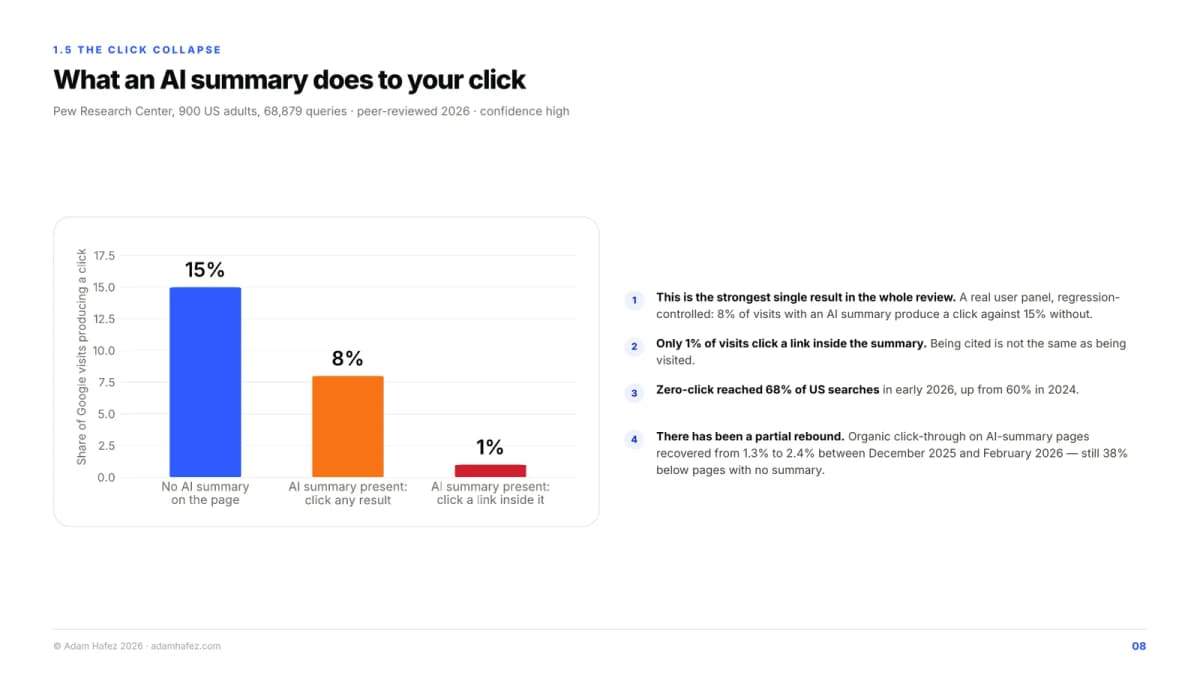
An AI summary halves the click: 8% against 15%, and 1% inside the summary
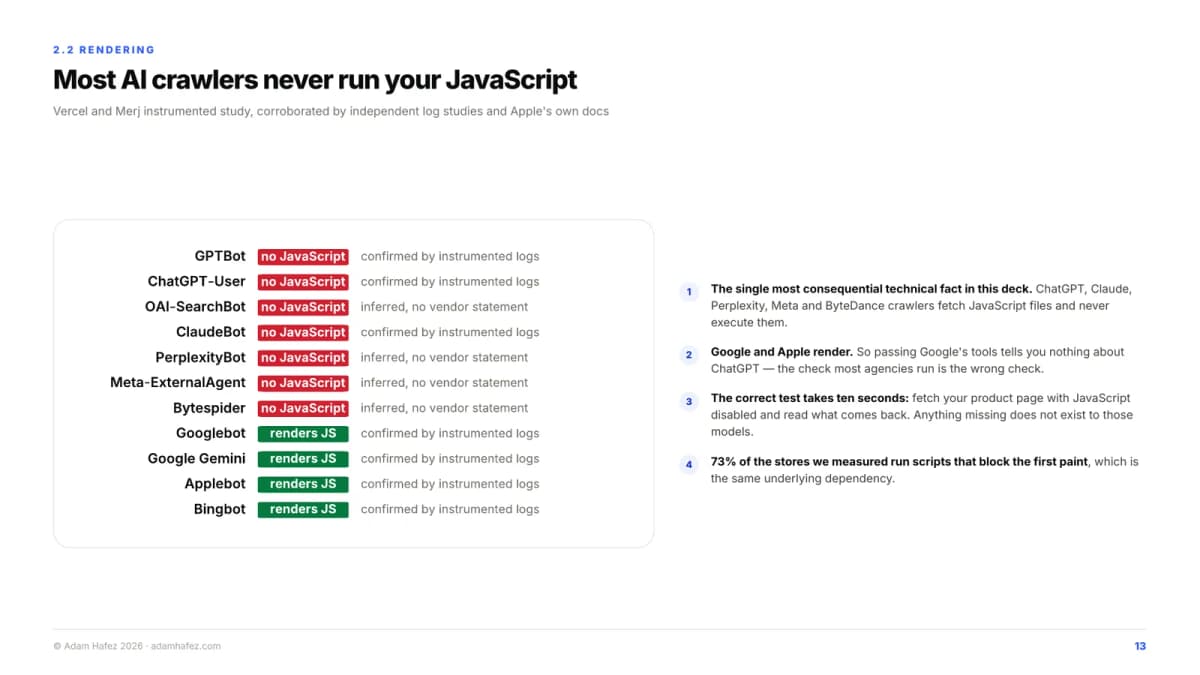
Which crawlers run JavaScript, and which never do
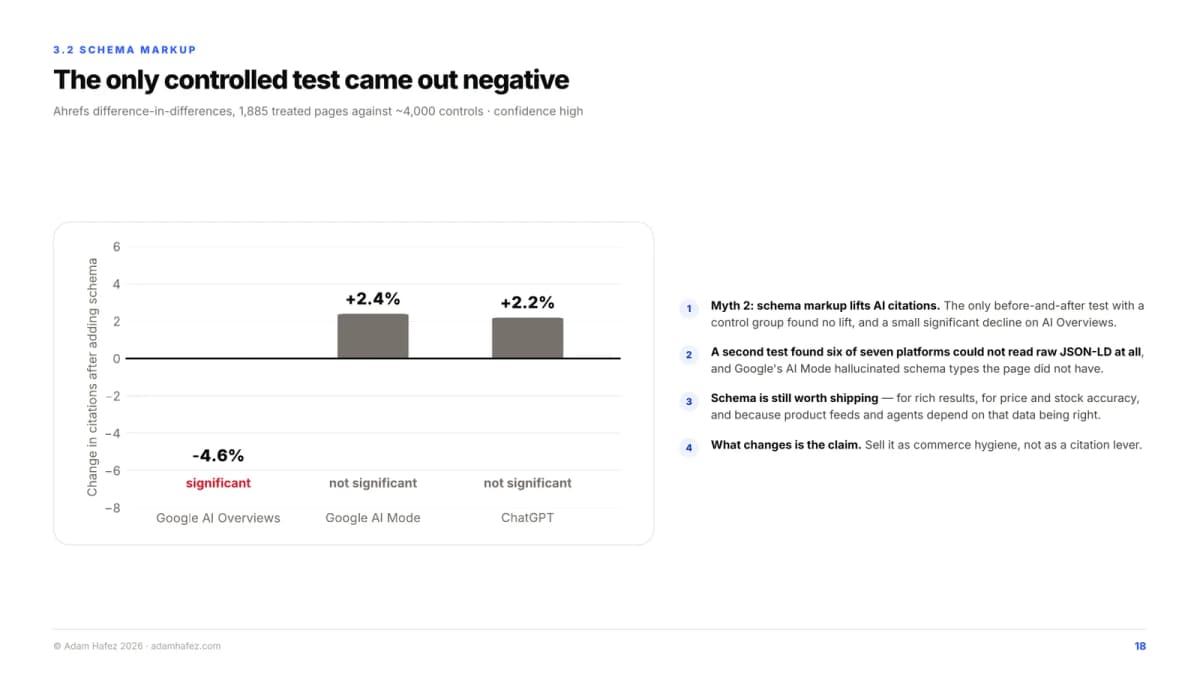
The only controlled schema test: no lift, and a significant decline on AI Overviews
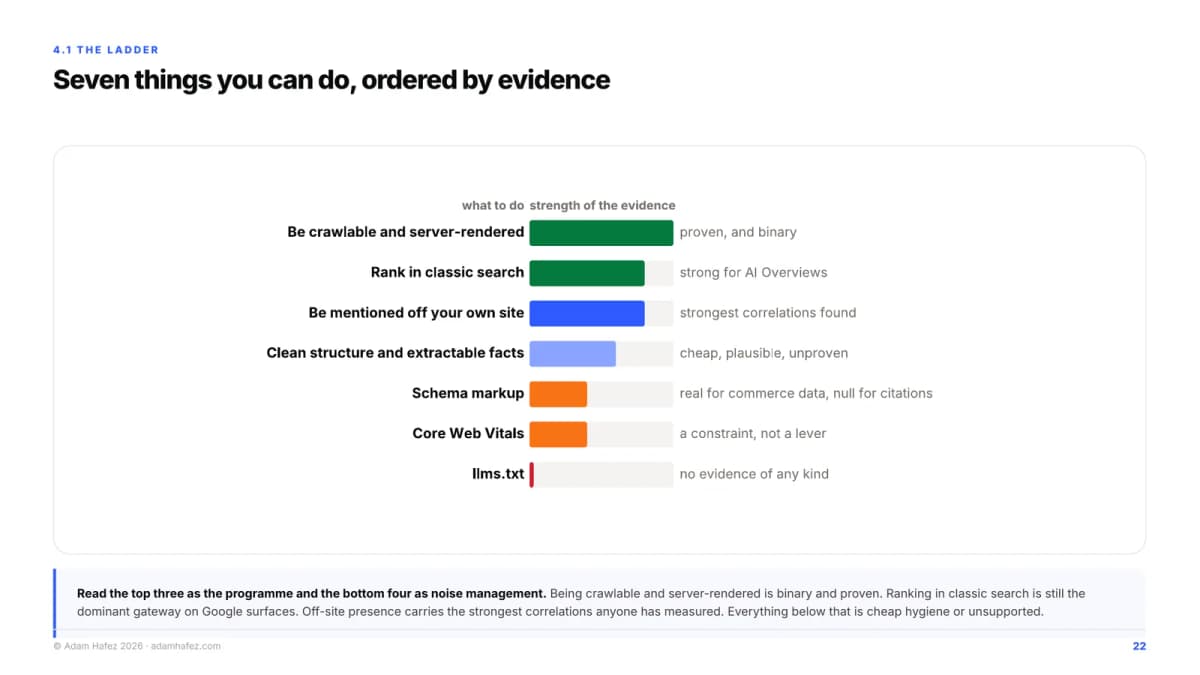
Seven things you can do, ordered by the strength of the evidence
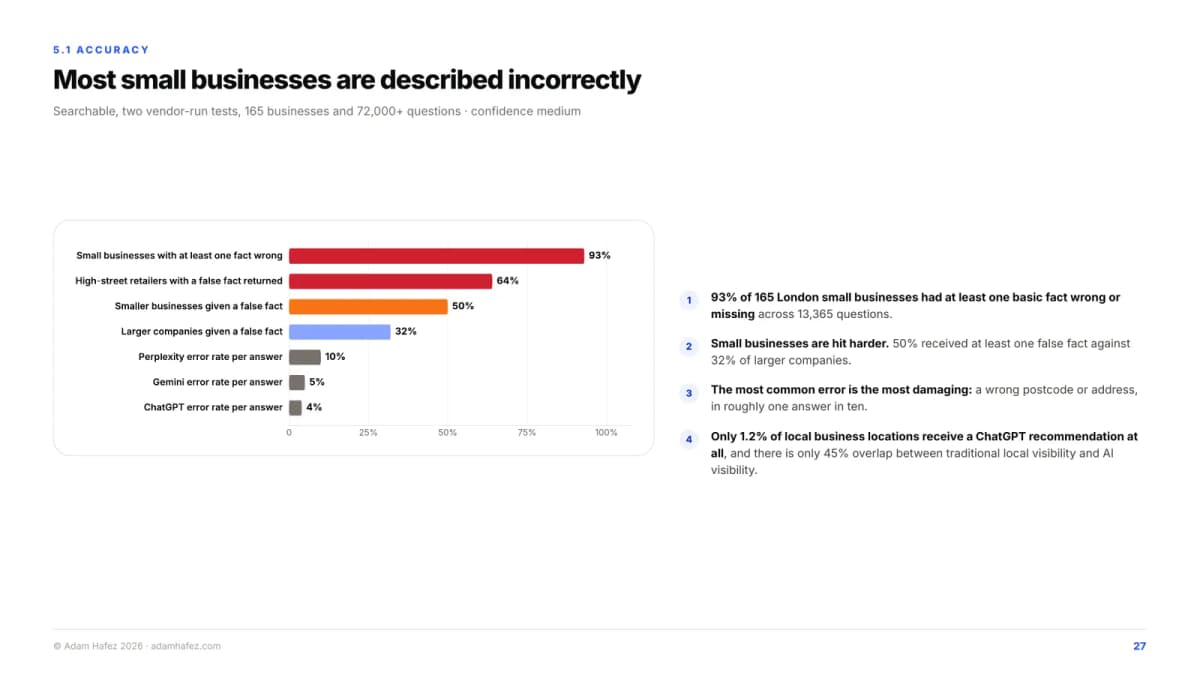
How often small businesses are described incorrectly
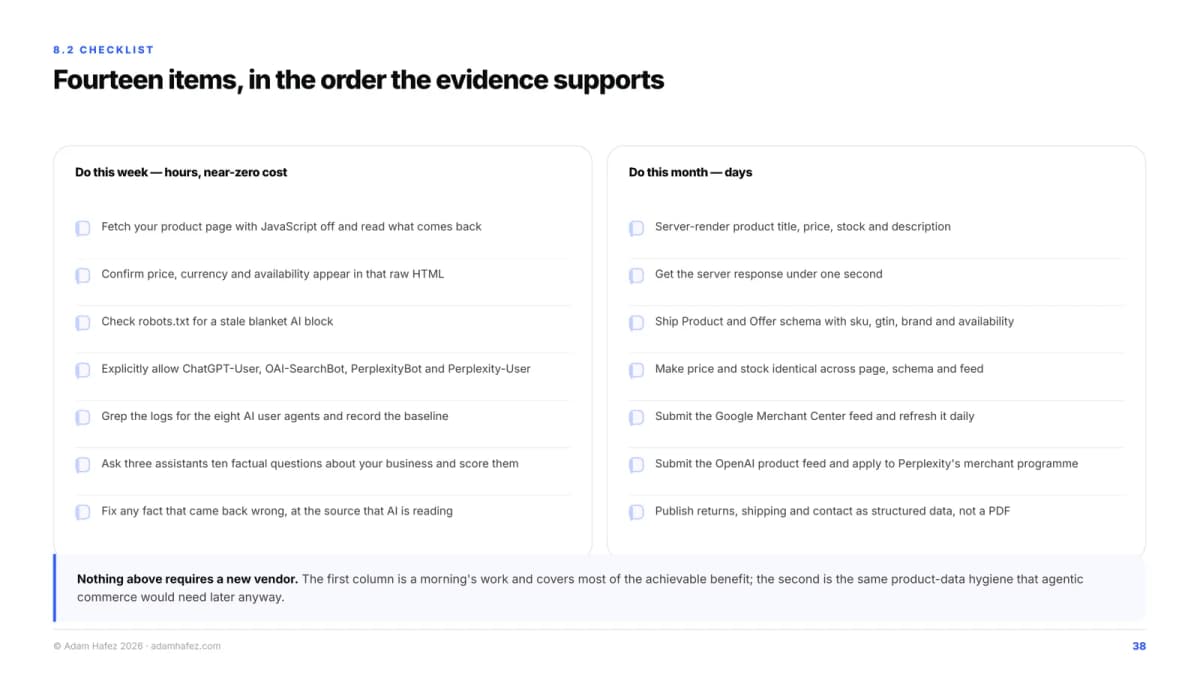
Fourteen items, in the order the evidence supports
10 findings
- 01
Most AI crawlers do not run JavaScript
ChatGPT, Claude, Perplexity, Meta and ByteDance fetch your JavaScript files and never execute them. Only Google and Apple render. If your price and description are drawn client-side, they do not exist to those models, and 73 percent of the stores measured run scripts that block the first paint.
- 02
An AI summary halves the click
Eight percent of Google visits with a summary produce a click, against fifteen percent without. Only one percent click a link inside the summary itself: being cited is not the same as being visited. Zero-click reached 68 percent of United States searches.
- 03
llms.txt does nothing
Across 137,210 domains, 97 percent of published llms.txt files received no request at all in a month, and AI crawlers never look for one that is missing. It is the most confidently sold item in the category and the least supported.
- 04
Schema is hygiene, not a citation lever
The only before-and-after test with a control group found no lift on two platforms and a small significant decline of 4.6 percent on AI Overviews. Ship it for rich results, price accuracy and agents, but stop selling it as a way to be cited.
- 05
Most crawling sends nobody
Four in five AI crawls are for training, which never sends a visitor. Google crawls about five pages per visitor referred; Anthropic's ratio runs into the tens of thousands. Crawl volume is a cost, not attention.
- 06
AI traffic stopped being worthless
It went from converting 97 percent worse than other channels to 42 percent better in eighteen months, on roughly one percent of visits. Small, growing, and now worth the plumbing.
- 07
This market is not ready for any of it
Across the 15,583 Middle East stores measured, not one AI-readability requirement is met by more than half of them. The gap is not strategy, it is server and markup work nobody has done.
- 08
Small businesses are described wrongly
93 percent of London small businesses had a fact stated incorrectly about them, and roughly half of long-tail product recommendations are hallucinated. For a small business the risk is not invisibility, it is a confident wrong answer.
- 09
Agentic checkout is not here yet
The flagship agentic checkout launched in September 2025 and was retired in March 2026, with about thirty live merchants. Discovery through AI is real and converting; buying through it is not, yet.
- 10
Six claims in circulation do not survive checking
The famous 40 percent GEO uplift is a simulator result, not a field one. Six widely repeated claims have no traceable study behind them, and each is named so it stays out of your deck.