
The CAC Reduction Playbook
What it costs to win a customer in 2026, why efficiency improved while retention weakened, and the five levers that move the number.
- Period
- 2024 to mid 2026
- Sample
- 342 companies benchmarked
- Findings
- 7

7 findings
- 01
Expansion costs half of new
One dollar of sales and marketing buys a dollar of expansion ARR against two dollars for a new customer. Expansion already supplies 40 percent of new ARR at the median, and 67 percent above $100M.
- 02
Your price tag sets your payback
Eleven months under $5K contract value against twenty two months at $50K to $100K. The $10K to $50K band is the most expensive segment in SaaS: too complex to self-serve, too small to justify field sales.
- 03
Attribution error beats the effect
Across 663 randomised experiments inside Facebook, non-experimental attribution was wrong by 62 to 115 percent against true lifts of 6 to 28 percent. eBay measured one campaign at +1,632 percent observationally and -63 percent experimentally.
- 04
You arrive at month 7.6 of 11.3
Eighty three percent of buyers start that first contact and 81 percent already have a preferred vendor when they do. Contacting earlier than the 70 percent mark measurably reduces win rates.
- 05
Two thirds of searches never click
Zero-click reached 68 percent of United States Google searches. Readers click a result on 8 percent of visits when an AI summary is present, against 15 percent without one, and being cited roughly doubles what click-through remains.
- 06
The gap is between companies
Payback runs from under six months to over twenty four, a spread wider than the gap between channels. In one advisory dataset the same channel returned 19x in the top quartile and 1.7x in the bottom.
- 07
Efficiency rose, retention fell
Blended CAC ratio fell 28 percent in a year while gross retention slid from 90 percent toward 84. Both are true at once, which is why the two workstreams have to run together: refilling a leaking bucket faster is not efficiency.
Inside the study
Pages from the file itself, not a mock-up of one.
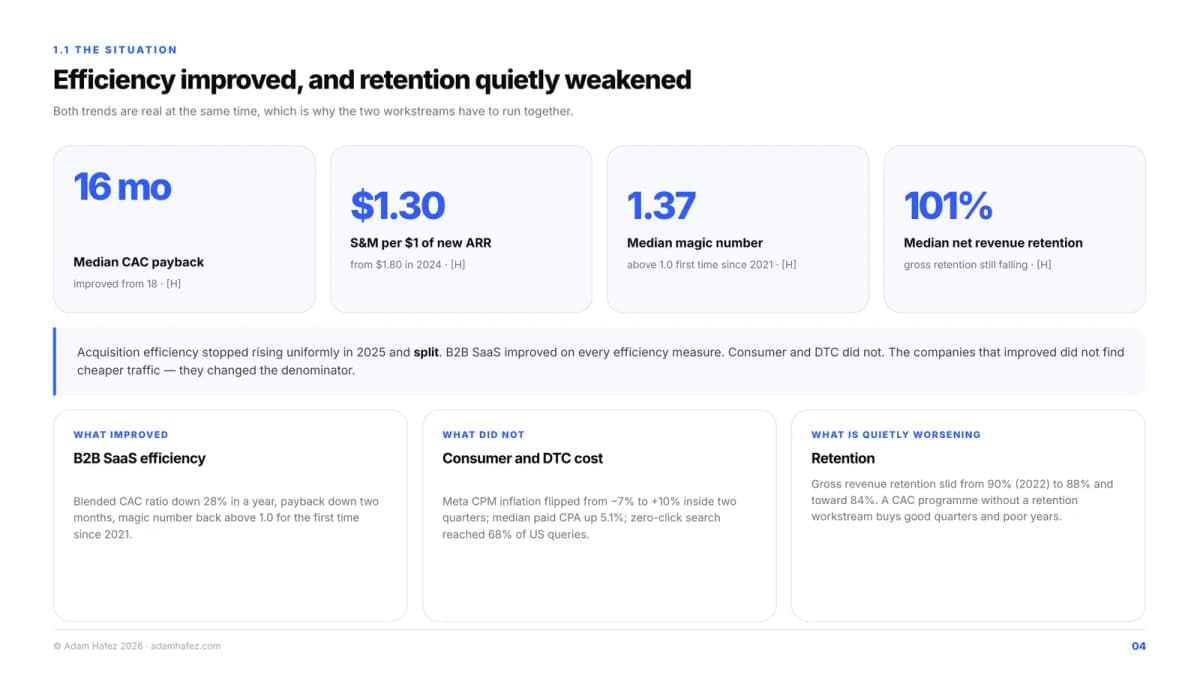
Efficiency improved while retention weakened, in four numbers
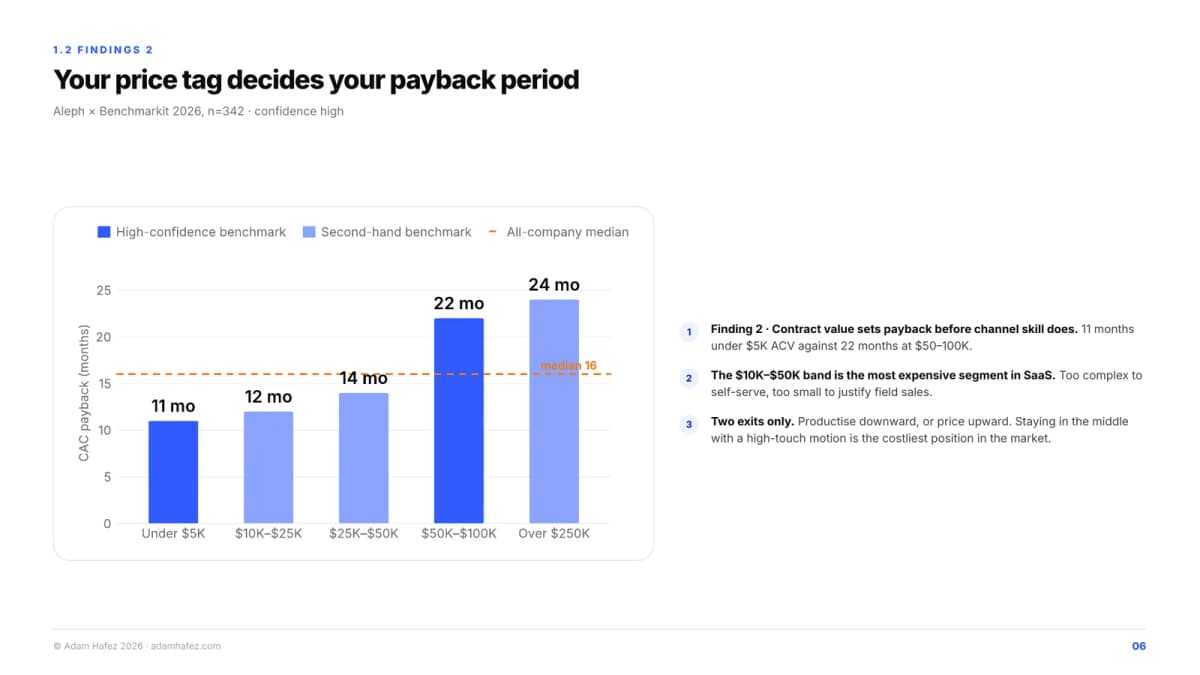
CAC payback by contract value: 11 months under $5K against 22 months at $50K to $100K
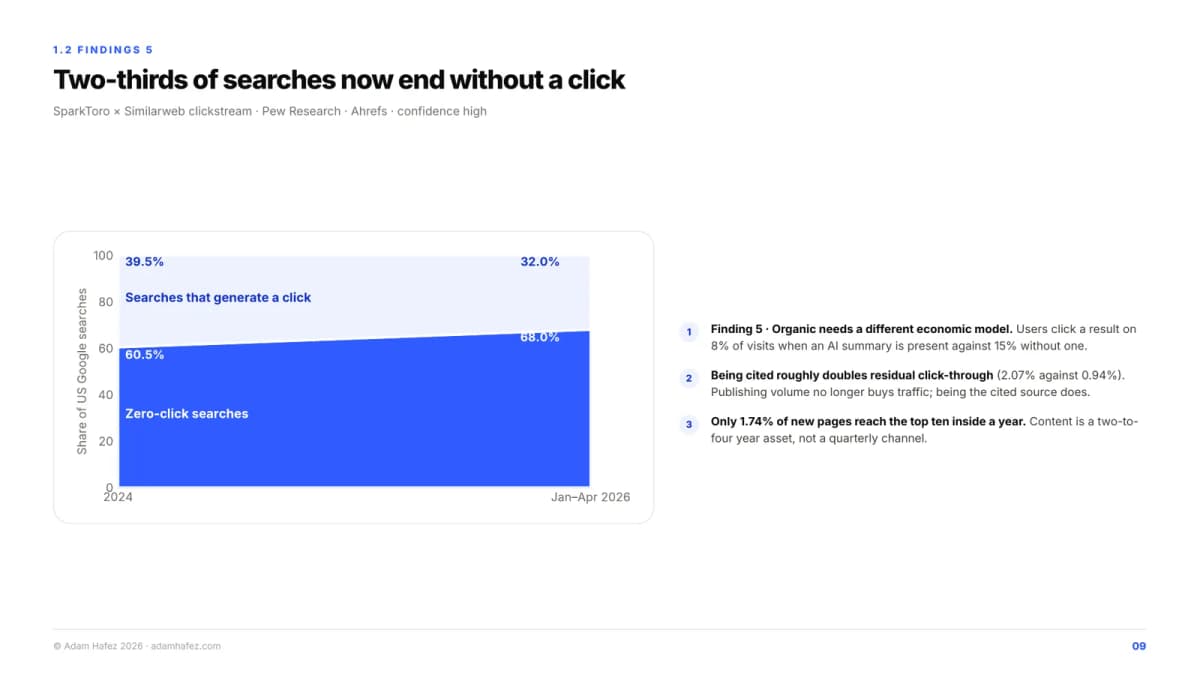
Zero-click searches rose from 60.5% to 68% of United States Google queries
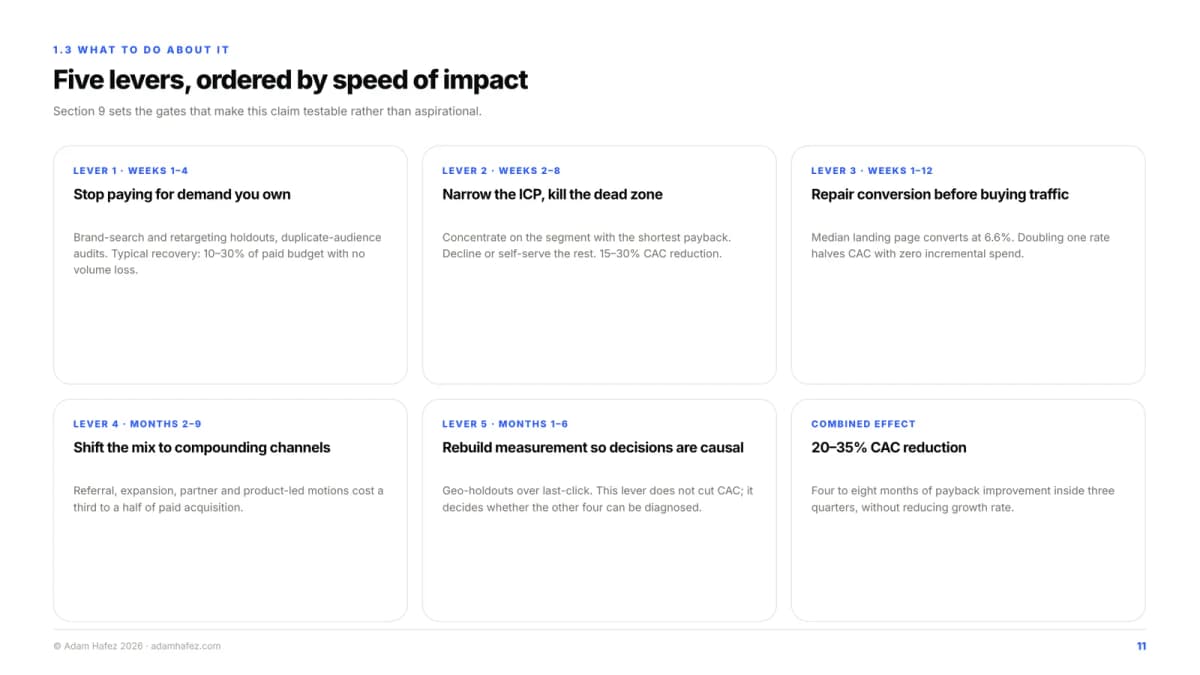
The five levers, ordered by speed of impact, with the combined 20 to 35% CAC reduction
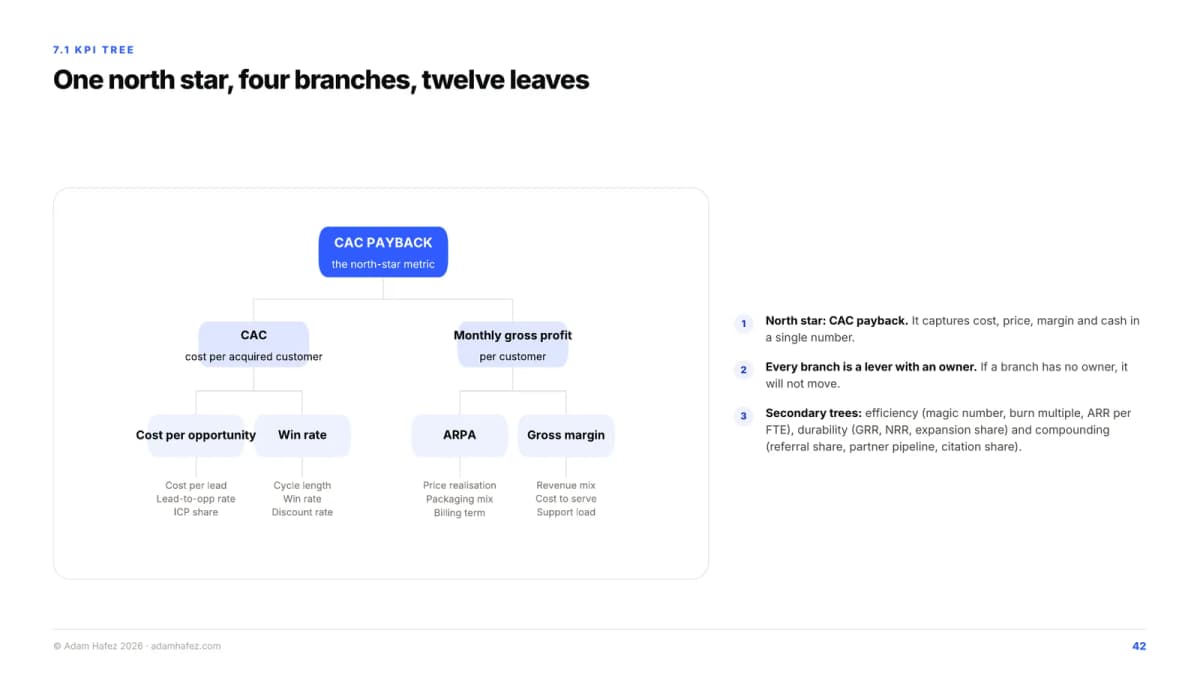
The KPI tree: one north star, four branches and twelve leaves
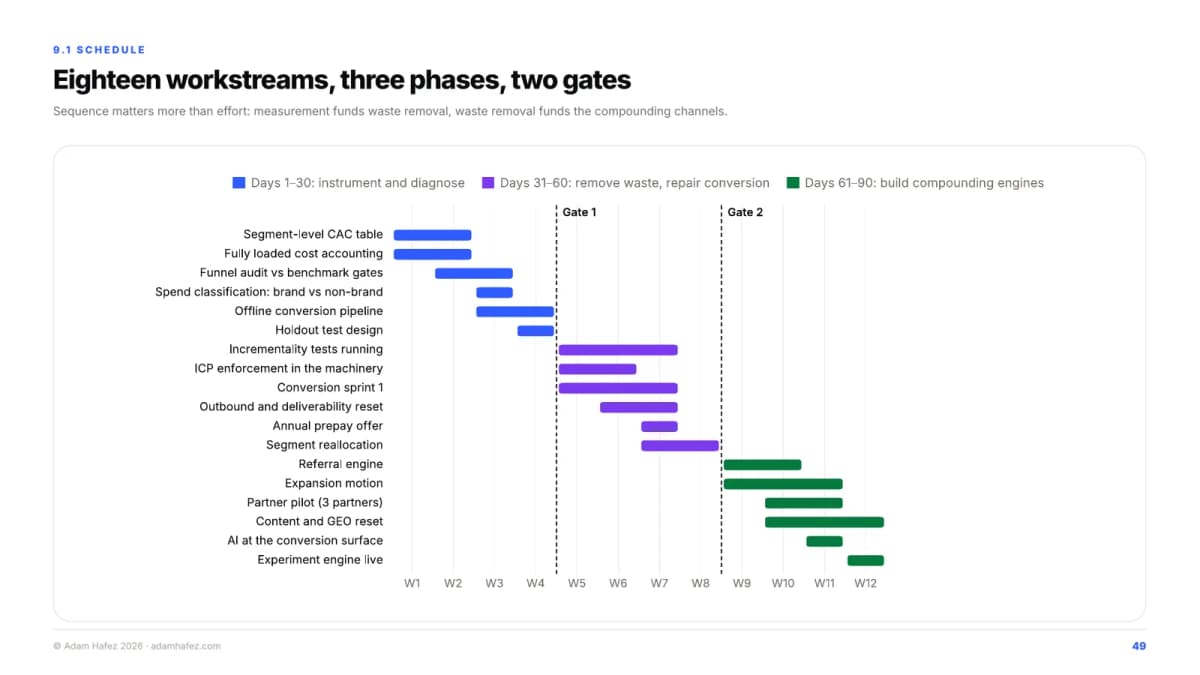
The 90-day plan as eighteen workstreams across three phases and two gates